 terravel
Terravel · Places · South America
Venezuela · South America
Orinoco River

What is Orinoco River, and where is it?
The Orinoco is one of South America's longest rivers, stretching 2,140 kilometers across Venezuela and Colombia. It drains a basin of roughly one million square kilometers and ranks third globally by water discharge volume, carrying immense quantities of rainforest runoff northeastward to the Atlantic Ocean.
Course and Basin Geography
The Orinoco forms a wide ellipsoidal arc that curves around the Guiana Shield, dividing into four distinct stretches. The upper section flows 286 kilometers through mountainous terrain in a northwesterly direction from its source at Cerro Delgado–Chalbaud, located at 1,047 meters above sea level near the Brazil border. The middle section extends 805 kilometers, first flowing westward to San Fernando de Atabapo, then northward along the Colombia–Venezuela border for about 290 kilometers, flanked by granitic upwellings that prevent flood plain development.
The lower Orinoco stretches 959 kilometers with a well-developed alluvial plain, flowing northeast from the Atures rapids to Barrancas. The delta region extends 200 kilometers, branching into hundreds of waterways across 41,000 square kilometers of swampy forest before emptying into the Gulf of Paria and Atlantic Ocean. The entire river system has a stream gradient of 0.05 percent, rising 1,047 meters over its 2,250-kilometer course.
Discharge Volume and Seasonal Variation
The Orinoco discharges approximately 39,000 cubic meters of water per second into the Atlantic, making it the third largest river globally by volume. This prodigious flow results from the basin's relentless precipitation of 2,300 millimeters annually across its catchment area. During the rainy season, the river swells to widths of 22 kilometers and depths of 100 meters, reshaping landscapes and carrying enormous sediment loads downstream.
The river's freshwater influence extends up to 100 miles into the Atlantic Ocean, noticeably reducing saltwater salinity in that region. The Guaviare River, with a flow of 8,200 cubic meters per second, serves as the main tributary, while other significant tributaries include the Caroní, Apure, Meta, and Arauca. A unique feature is the Casiquiare canal, which branches from the Orinoco and connects to the Rio Negro, a tributary of the Amazon, creating a natural distributary between two major river systems.
Ecological Diversity and Wildlife
The Orinoco basin supports extremely diverse wildlife adapted to freshwater and wetland environments. The boto and giant otter inhabit the river system, while the Orinoco crocodile, one of the world's rarest reptiles, has its wild range restricted to the middle and lower basin. More than 1,000 fish species have been recorded, with approximately 15 percent endemic to the basin. The Characiformes and Siluriformes orders account for more than 80 percent of freshwater species, including the black spot piranha and cardinal tetra.
The Casiquiare canal's unique combination of blackwater and clear-to-whitewater sections allows only relatively adaptable species to pass between the Orinoco and Amazon systems. The river's vast floodplain forests and delta wetlands provide critical habitat for migratory birds, caimans, anacondas, and countless invertebrate species. The basin's high precipitation and complex hydrology create distinct ecological zones that support specialized plant and animal communities adapted to seasonal flooding and nutrient-rich waters.
Historical Exploration and European Contact
Christopher Columbus documented the Orinoco's mouth at the Atlantic Ocean on August 1, 1498, during his third voyage. Sixteenth-century German expeditions under Ambrosius Ehinger explored the river and its tributaries in the eastern Llanos. Diego de Ordaz sailed upstream from the delta's Boca de Navios to the Meta River in 1531, while Antonio de Berrio later navigated the Casanare to the Meta and down the Orinoco. Sir Walter Raleigh sailed the river in 1595 while seeking the legendary city of El Dorado.
Alexander von Humboldt and Aimé Bonpland explored stretches of the Orinoco from April to May 1800, documenting pink river dolphins and publishing extensively on the river's flora and fauna. Humboldt sought to prove that South America's waterways formed an interconnected system from the Andes to the Amazon. The river's source at Cerro Delgado–Chalbaud was discovered in 1951 by a French-Venezuelan expedition led by Venezuelan army officer Frank Risquez Iribarren, exploring the upper course near the Sierra Parima and Brazil border.
Modern Infrastructure and Economic Use
The Orinoco serves as the major transportation system for eastern and interior Venezuela and the Llanos plain of Colombia. The river remains navigable for most of its length, with dredging enabling ocean ships to reach Ciudad Bolívar, 435 kilometers upstream at the confluence with the Caroní River. Cargo steamers continue upriver to Puerto Ayacucho near the Atures Rapids. The Angostura Bridge at Ciudad Bolívar, completed in 1967, was the first bridge across the river, followed by the Orinoquia Bridge near Ciudad Guayana in 2006.
Iron ore mining began near the delta south of San Feliz in the 1920s and expanded significantly after World War II through Venezuelan and US steel company operations. The early 1950s saw approximately 10,000 tons of ore-bearing soil extracted daily. The river deposits contain extensive tar sands in the Orinoco oil belt, considered a potential source for future oil production. Since 1973, the Internacional Rally Nuestros Rios son Navegables has organized a 1,200-kilometer motonautical competition through the Orinoco, Meta, and Apure rivers, recognized as the world's longest fluvial rally.
Where is Orinoco River?
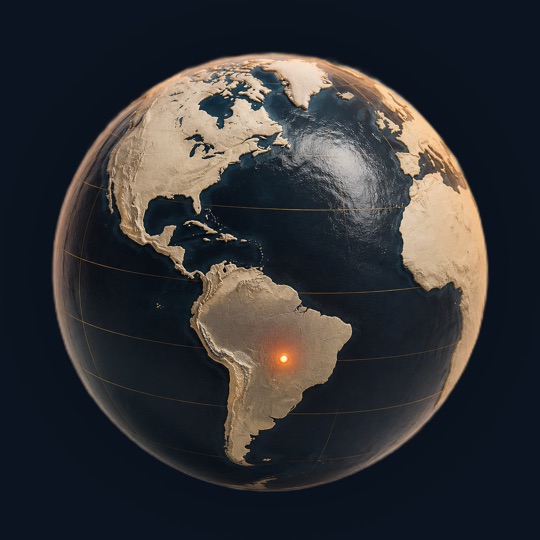
Orinoco River is in Venezuela, South America, at 2.32°N, 63.36°W. The closest places in the Terravel atlas are La Guajira Desert (1,414 km), Sacred Valley (1,989 km) and Machu Picchu (1,998 km).
Photos of Orinoco River

Photo: Dilankf · CC BY-SA 4.0

Photo: Anagoria · CC BY 3.0

Photo: Pedro Gutiérrez. · CC BY 2.0
Orinoco River at a glance
Questions about Orinoco River
What does the name Orinoco mean?
The river's name derives from the Warao term meaning 'a place to paddle,' combining güiri (paddle) and noko (place), reflecting its historical importance as a navigable waterway for indigenous peoples.
How does the Casiquiare canal connect two river systems?
The Casiquiare canal branches from the Orinoco as a distributary and flows to the Rio Negro, a tributary of the Amazon. This natural canal creates a unique connection between the two major river systems, allowing only adaptable fish species to pass through its mixed blackwater and clear-to-whitewater sections.
Why is the Orinoco crocodile considered rare?
The Orinoco crocodile is one of the world's rarest reptiles, with its wild range restricted to the middle and lower Orinoco River basin. Habitat loss and historical hunting have severely limited its population to this specific region.
How far upstream can large ships travel on the Orinoco?
Ocean ships can reach Ciudad Bolívar, located 435 kilometers upstream at the confluence with the Caroní River, thanks to dredging operations. River steamers can continue further to Puerto Ayacucho and the Atures Rapids.
What makes the Orinoco's discharge volume significant?
The Orinoco discharges approximately 39,000 cubic meters of water per second, ranking it third globally by volume. Its freshwater influence extends up to 100 miles into the Atlantic Ocean, noticeably reducing saltwater salinity in that region.
Sources and further reading
This article was written from the reference material below, retrieved and reviewed for source alignment on September 13, 2026. Use official local sources for changing access or travel information.
About this page. Terravel combines its curated place catalog with credited photography and geographic reference data. Practical travel details can change; use the linked destination guide and official local sources when planning a trip. Send a correction.
Test yourself
Which river's freshwater discharge is so vast it dilutes the Atlantic Ocean up to 100 miles from shore?
The Orinoco River in Venezuela discharges such an enormous volume of water—the world's fourth largest by discharge—that it freshens Atlantic seawater measurably far out to sea, a fact unique among the wrong options.
Can you place today's?
Orinoco River is one of 266 places in Terravel. A new one every morning.
Go beyond the familiar in South America
Start with a place you know, then follow the map toward somewhere less expected.


